
Reaction Time Test: Check Your Reflexes & Response Speed (Free Tool)
Welcome to our free reaction time test! This tool measures your response speed in milliseconds and helps you check your reflex performance using a simple visual reaction test. No downloads, no signups, just instant results.
How to use it:
- Click the “Start Test” button above
- Wait for the red color to change to green
- Click as fast as possible when you see green
- Your reaction time will be displayed in milliseconds
For best results:
- Close other browser tabs and apps
- Use a comfortable sitting position
- Keep your mouse finger ready
- Stay focused on the test area
- Take multiple tests for average results
Understanding Your Results
Excellent: Under 150ms
Good: 150-200ms
Average: 200-300ms
Below Average: 300-400ms
Slow: Over 400ms
Your score depends on several factors, including age, alertness, practice, and even the time of day. Don’t worry if your first attempt isn’t perfect; reaction time improves with regular testing and training.
What is Reaction Time?
Reaction time is the interval between a stimulus (like a color change) and your response to it. It measures how quickly your nervous system processes information and triggers a physical action. In gaming, sports, and daily activities, faster reaction times give you a competitive edge.
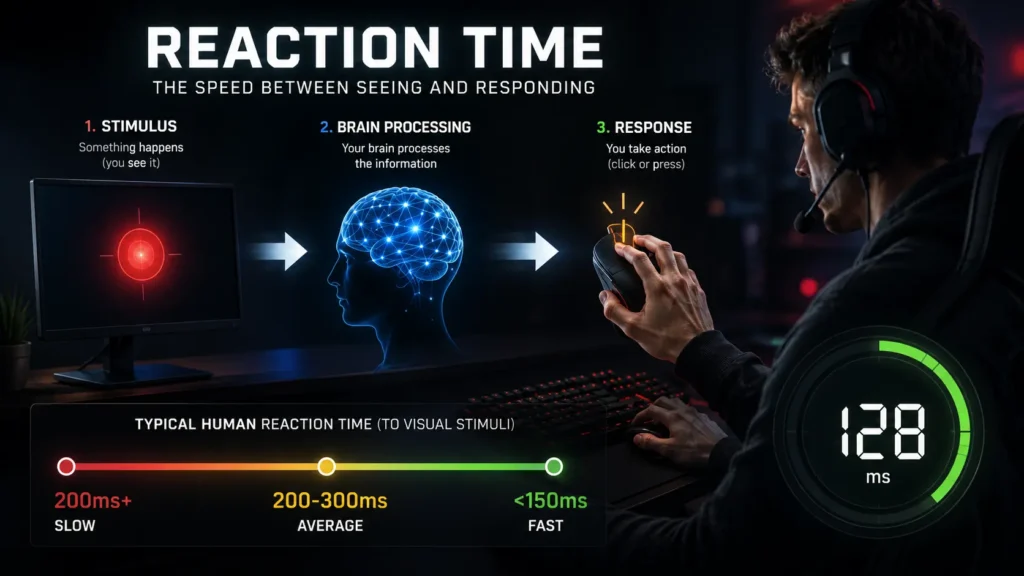
The average human reaction time to visual stimuli ranges from 200 to 300 milliseconds. Professional gamers and athletes often achieve times below 150ms through consistent practice and training.
How Does the Reaction Time Test Work?
Our reaction time tester uses a simple yet scientifically accurate method:
- Visual Stimulus: You wait for a red box to turn green (randomized delay prevents anticipation)
- Neural Processing: Your eyes detect the color change and send signals to your brain
- Motor Response: Your brain processes the information and commands your finger to click
- Measurement: The tool calculates the exact time between stimulus and response
What Is a Good Reaction Time?
Your reaction time is the difference between your brain seeing something and your body actually doing something about it – measured in milliseconds (ms). The lower the number, the faster your reflexes. And where you fall on the scale depends a lot on your age, how much sleep you got last night, and honestly, whether you’ve ever trained for it.
Here’s a simple breakdown of where most people land:
| Reaction time | Rating | Who it typically describes |
|---|---|---|
| Under 150ms | Superhuman | Extremely rare — likely predictive, not purely reactive |
| 150–200ms | Excellent | Top 1% — elite pro gamers and trained athletes |
| 200–250ms | Good | Above average — competitive gamers, young adults |
| 250–300ms | Average | Most healthy adults in their prime |
| 300–400ms | Below average | Untrained, fatigued, or older adults |
| 400ms+ | Slow | May indicate fatigue, age-related decline, or distractions |
One thing to keep in mind: any online milliseconds test adds a bit of extra time from your device, browser, and display. Usually 10–30ms. So if your score says 245ms, your actual neurological reaction speed is probably a little quicker than that. Don’t stress the exact number — trends across multiple attempts matter more than a single result.
Average Human Reaction Time in Milliseconds
Most people agree that their reactions are either great or terrible. The truth is that almost everyone falls into a very narrow range.
For a visual stimulus — like waiting for a color to change on screen — the average human reaction time sits somewhere between 200 and 250ms for healthy adults in their 20s and 30s. That’s the biological sweet spot, the age when your nervous system is firing at its fastest.
In real-world speed reaction tests though, most people score closer to 250–300ms. And that’s completely normal. Your screen has a little delay. Your brain takes a split second to decide it’s actually time to click. Your finger has to physically travel. It all adds up.
What Is the Fastest Human Reaction Time?
The fastest verified human reaction time on record is around 100–120ms. At that speed, the response is right at the boundary of what’s considered a true reaction — anything under 100ms is generally classified as anticipatory (meaning the person predicted the signal rather than purely reacting to it).
Reaction Time Benchmarks – How Do You Compare?
Numbers only make sense when you have something to measure them against. Scoring 230ms on a speed reaction test feels meaningless until you know that most people score between 250 and 300ms, and that pro gamers spend months grinding to break 200ms consistently.
Here’s where different groups actually land:
| Group | Average reaction time |
|---|---|
| Elite pro gamers (CS:GO, Valorant) | 150–180ms |
| F1 drivers (race start) | 180–220ms |
| Professional athletes | 180–230ms |
| Young adults (18–30) | 200–250ms |
| Average online test user | 250–280ms |
| Adults (30–50) | 250–320ms |
| Adults (50+) | 320–420ms |
The ranges here aren’t meant to make anyone feel bad about their score. Reaction time is one of those things that’s partly biological, partly trained, and very much affected by how you’re feeling on any given day. A poor night of sleep can add 50ms to your result without you even noticing.
Pro Gamer vs Average Gamer Reaction Time
Pro FPS gamers do have faster reaction times than average players. But the gap is smaller than most people expect. The average competitive pro in games like CS:GO or Valorant scores somewhere around 150–180ms on a clean reaction time test. A decent amateur who games regularly might score 200–240ms. The gap between them is real, but it’s roughly 50–80ms.
What actually makes pros faster in-game isn’t purely reaction speed. It’s three things:
- Game sense
- Consistency
- Hardware
How to Measure Your Reaction Time?
Measuring your reaction time is easier than ever. The two most common methods are online reaction time tests and the traditional ruler drop test. While both can provide useful insights, they differ significantly in terms of accuracy, convenience, and consistency.
Online Reaction Time Test (Fastest Method)
The quickest and most accurate way to measure your reaction time is by using an online reaction time test.
Our Reaction Time Test Tool offers one of the easiest and most reliable ways to check your reflex speed. Simply wait for the screen color to change and click as quickly as possible. Within seconds, you’ll receive your reaction time score along with multiple attempts for a more accurate average result.
Why Use Our Online Reaction Time Test?
- Instant results in milliseconds
- No equipment required
- Works on desktop, tablet, and mobile devices
- Multiple attempts for better accuracy
- Ideal for gamers, athletes, students, and anyone curious about their reflexes
- Free and available anytime
The Ruler Drop / Pole Catcher Method
Before online tests became popular, reaction time was often measured using a ruler or pole catcher test. This method is still commonly used in schools, sports training programs, and science experiments.
Why Test Your Reaction Time?
Testing your reaction time offers practical benefits:
- Gaming Performance: Faster reflexes improve your competitive edge in FPS games, racing simulators, and esports
- Cognitive Health: Regular testing tracks mental alertness and cognitive function over time
- Athletic Training: Athletes use reaction time tests to enhance performance in sports like tennis, boxing, and baseball
- Fatigue Detection: Slower reaction times can indicate a lack of sleep or mental exhaustion
- Progress Tracking: Monitor improvement through consistent practice and training
Tips to Improve Your Reaction Time
1. Practice Regularly
Take this test daily to build neural pathways and muscle memory. Consistent practice can reduce your reaction time by 10-20% over several weeks.
2. Get Quality Sleep
Sleep deprivation significantly slows reaction speed. Aim for 7-9 hours of quality sleep to maintain optimal cognitive function and quick reflexes.
3. Stay Physically Active
Regular exercise improves overall nervous system function, coordination, and reaction speed. Activities like table tennis and boxing are particularly effective.
4. Eliminate Distractions
Focus is crucial. Close unnecessary browser tabs, silence notifications, and test in a quiet environment for the most accurate measurements.
5. Maintain Proper Nutrition
Your brain needs fuel. Eat foods rich in omega-3 fatty acids, antioxidants, and vitamins to support neural health and processing speed.
6. Stay Hydrated
Even mild dehydration can impair cognitive performance and slow reaction times. Drink adequate water throughout the day.
How Does FPS Affect Your Reaction Time?
Your reaction speed isn’t fixed, it varies based on:
- Age: Reaction time peaks in your 20s and gradually slows with age
- Alertness: Fatigue, drowsiness, and lack of sleep slow responses
- Practice: Regular testing and gaming improve reaction speed
- Time of Day: Most people react fastest in late morning and early evening
- Stimulus Type: Audio reactions (140-160ms) are typically faster than visual reactions (150-300ms)
- Distractions: Background noise and multitasking increase reaction time
- Physical Condition: Health, fitness level, and injury recovery affect performance
Reaction Time in Gaming
For competitive gamers, reaction time is a critical skill. The difference between 150ms and 250ms can determine victory or defeat in fast-paced games like:
- FPS Games: Counter-Strike, Valorant, Call of Duty
- Battle Royale: Fortnite, PUBG, Apex Legends
- Fighting Games: Street Fighter, Mortal Kombat
- Racing Games: Gran Turismo, F1 series
Pro gamers consistently achieve reaction times under 180ms through dedicated training and optimal gaming setups.